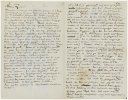
1r:1
Your letter has just arrived, for which I thank you. I’m glad to read once more that you take pleasure in the woodcuts. I also respect your views regarding what I’ve sent from time to time, and hope to go on sending unless you have an objection. But I’m faced by a difficult question — one that’s actually impossible for me to decide and yet I will decide it — namely, to say what they cost me. As you know, I have a particular liking for woodcuts. I usually buy them very cheaply, and yet by my standards I spend quite a lot on them and have never regretted that. Whether I paid more or less for them, though, has nothing to do with what I sent to you — since I sent you duplicates and nothing that I didn’t already have myself, as you saw in fact this summer when we sorted out the duplicates together.
I didn’t buy what I sent you especially for you — apart from a few exceptions, and for those few exceptions I only paid a little and only wish I could find more like them. But since you insist, I will charge you, say one
daalder,
1 which you can send me if you like, for example in stamps at your convenience. Then you needn’t have any misgivings about not dealing fairly with me financially. So in this way I believe this question is settled.
1r:2 Now I’ve asked you to tell me whether you receive magazines like, for example, L’Illustration or The Graphic regularly, that’s to say this year’s issues. This is because I’m in negotiations with someone who’s selling a number of magazines that come from a subscription library.
2 I’ve decided to take them in any case, but I already have one or two from the current year, so I’ll probably get some duplicates again. If they come from L’Illustration, for example, and if I know you already have L’Illustration, I’ll give the duplicates, when there’s an opportunity, to someone else who might enjoy them and collects them (though at the moment I don’t know of anyone for them). But if I know you don’t have them, then of course they’re yours.
I had just agreed to take this batch, even before I had received your letter, and hope to have them within a fortnight or so, perhaps even sooner — so let me know, if you would, what your position is as regards magazines in 1882.
Of course I don’t yet know whether I’ll have a lot of duplicates or not, but there are bound to be some.
So be so good as to let me know about this. I’ll charge you something again if it’s worth the trouble, or we can settle it when the opportunity arises, but oblige me by telling me if I can be of service. I take an interest in your collection, and would like to see it become a very fine one. Later I may be able to send more important things.
1v:3 I already have about 40 large and small prints by
Renouard.
3 Recently I found The exchange
4 and A speech by M. Gambetta
5 and prints from the orphanage
6 by him. But above all I’m certain you would take great pleasure in a couple of large
Lançons.
7Caton Woodville 8 is also very good. The more I see of him, the more I’m beginning to like him. Do you know
Montbard? I believe you do at least have landscapes by him. But lately I got some sketches by him of
Ireland9 and of
Jernsey10 in which there was a great deal of sentiment.
I sincerely hope that you’ll take pleasure in your painting at Arti.
11 I don’t think I’ll see the exhibition.
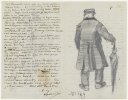
I’m very busy with drawings of an
orphan man, as the almsmen are usually called here. Don’t you think that the expressions orphan man and orphan woman are just right?
12 It isn’t easy to do the types one comes across on the street.
As to watercolours, I have several that I’ve started, but they haven’t yet worked out as I wished, but I’m enjoying it more than in the past. Here’s a scratch of an orphan man
13 — adieu, I write in haste — so let me know soon about the woodcuts, whether you have them or not. With a handshake,
Ever yours,
Vincent


![[381]](/vg/interface/artworkref.png "Charles Paul Renouard - The exchange and the brokers (Click to view image)")
![[381]](/vg/illustrations/381t.jpg "Charles Paul Renouard - The exchange and the brokers")
![[385]](/vg/illustrations/385t.jpg "Charles Paul Renouard - A speech by M. Gambetta: Gestures and attitudes")
![[1956]](/vg/illustrations/1956t.jpg "Charles Paul Renouard - The crèche (Les enfants assistés)")
![[1957]](/vg/illustrations/1957t.jpg "Charles Paul Renouard - The change (Les enfants assistés)")
![[1970]](/vg/illustrations/1970t.jpg "Charles Paul Renouard - The meal of the weaned babies – A scrofulous child – A rachitic child – They learn to walk (Les enfants assistés)")
![[1959]](/vg/illustrations/1959t.jpg "Charles Paul Renouard - Time for porridge (Les enfants assistés)")
![[396]](/vg/illustrations/396t.jpg "Charles Paul Renouard - The first group goes to the dining room (Les enfants assistés)")
![[395]](/vg/illustrations/395t.jpg "Charles Paul Renouard - Number 68,782 (Les enfants assistés)")
![[1978]](/vg/illustrations/1978t.jpg "Charles Paul Renouard - In the foundlings’ house. Abandonment (Les enfants assistés)")
![[1958]](/vg/illustrations/1958t.jpg "G. Montbard (pseudonym of Charles Auguste Loye) - Irish peasants resting on the way back from a party (Irish types and physiognomies)")
![[1979]](/vg/illustrations/1979t.jpg "G. Montbard (pseudonym of Charles Auguste Loye) - An Irish interior (Irish types and physiognomies)")
![[1980]](/vg/illustrations/1980t.jpg "G. Montbard (pseudonym of Charles Auguste Loye) - An eviction (Irish customs)")
![[3026]](/vg/illustrations/3026t.jpg "Vincent van Gogh - Old man with an umbrella seen from the back (F 968 / JH 213)")