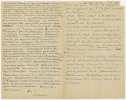
1r:1
My dear Theo,
Letter from
Gauguin, who tells me that he’s sent you a consignment of paintings and studies.
1Would be very pleased if you could find the time to write and give me some details of what they are.
His letter was accompanied by a letter from
Bernard, to say that they’d received my consignment of canvases, that they’re going to keep all 7 of them. Bernard will make another study for me in exchange,
2 and the three others,
Moret,
Laval and a young
chap,
3 will also send portraits, I hope.
Gauguin has my portrait,
4 and
Bernard says that he’d like to have one like it, although he already has one of me, which I exchanged with him at the time for the portrait of his Grandmother.
5 And it pleased me that they weren’t averse to what I had done in figure painting.
6
1v:2
I was, and still am, almost knocked out by last week’s work.
I still can’t do anything, but in any case there’s a very violent mistral, which raises clouds of dust that turns the trees on boulevard des Lices
7 white from top to bottom. So I’m pretty well forced to take it easy. I’ve just slept for 16 hours at a stretch, which has gone a long way to making me myself again.
And tomorrow I’ll have got over this exhaustion.
But I made a good week of it, eh, with 5 canvases;
8 if it gets a bit of its own back this week, well, it’s natural.
1v:3 If I’d worked more calmly, you can see clearly that the mistral would have caught me out again.
Ah, if the weather’s fine here you have to take advantage of it, otherwise you’d never do anything.
But tell me what
Seurat’s doing. If you see him, tell him on my behalf that I have in progress a decoration which at present amounts to 15 square no. 30 canvases,
9 and which, to make an ensemble, will take at least 15 more, and that in this work on a broader scale it’s often the memory of his personality and of the visit that we made to his studio to see his beautiful big canvases
10 that gives me courage in this task.
I’d very much like us to have
Seurat’s portrait of himself.
11
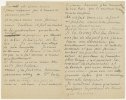
1r:4 I had told
Gauguin that the reason I had urged him to make an exchange of portraits was because I believed that he and
Bernard would certainly have made several studies, each of the other. That as that wasn’t the case and he had done the portrait especially for me, I didn’t want it as an exchange, considering the thing too important.
12 He writes to say that he really does wish me to take it as an exchange. His letter is again very complimentary, as I don’t deserve it, let’s pass over it. I’m sending you article on Provence which seemed well-written to me.
13 These
Félibres are a literary and artistic circle:
Clovis Hugues,
Mistral, others, who write quite good, even sometimes very good sonnets in Provençal and sometimes in French.
14If one day the Félibres stop being unaware of my existence, they’ll all visit the little house. I prefer that it not happen before I’ve finished my decoration. But loving Provence as whole-heartedly as they do, I perhaps have a right to their interest. If ever I insist on that right, it will be so that my work remains here or in Marseille, where, as you know, I’d like to work, believing that the Marseille artists would do well to continue what their
Monticelli started.
If
Gauguin and I write an article in one of the papers here, that will be enough to make contact. Handshake.
Ever yours,
Vincent



![[118]](/vg/interface/artworkref.png "(Eugène Henri) Paul Gauguin - The vision after the sermon (Click to view image)")
![[118]](/vg/illustrations/118t.jpg "(Eugène Henri) Paul Gauguin - The vision after the sermon")
![[102]](/vg/illustrations/102t.jpg "(Eugène Henri) Paul Gauguin - Breton girls dancing")
![[780]](/vg/illustrations/780t.jpg "Carlo (Carlino) Dolci - Christ in Gethsemane")
![[2700]](/vg/illustrations/2700t.jpg "Vincent van Gogh - Quay with sand barges (F 449 / JH 1558)")
![[2261]](/vg/illustrations/2261t.jpg "Emile Bernard - Self-portrait with portrait of Gauguin")
![[2686]](/vg/illustrations/2686t.jpg "Vincent van Gogh - Garden with flowers (F 578 / JH 1538)")
![[2715]](/vg/illustrations/2715t.jpg "Vincent van Gogh - Self-portrait (F 476 / JH 1581)")
![[2552]](/vg/illustrations/2552t.jpg "Vincent van Gogh - Self-portrait with a straw hat (F 526 / JH 1309)")
![[2212]](/vg/illustrations/2212t.jpg "Emile Bernard - Bernard’s grandmother")
![[2656]](/vg/illustrations/2656t.jpg "Vincent van Gogh - Zouave (F 1482 / JH 1487)")
![[2718]](/vg/illustrations/2718t.jpg "Vincent van Gogh - Entrance to the public garden (F 566 / JH 1585)")
![[2733]](/vg/illustrations/2733t.jpg "Vincent van Gogh - The Tarascon diligence (F 478a / JH 1605)")
![[2730]](/vg/illustrations/2730t.jpg "Vincent van Gogh - The public garden with a couple strolling (‘The poet’s garden’) (F 479 / JH 1601)")
![[2731]](/vg/illustrations/2731t.jpg "Vincent van Gogh - The viaduct (F 480 /JH 1603)")
![[2732]](/vg/illustrations/2732t.jpg "Vincent van Gogh - The Trinquetaille bridge (F 481 / JH 1604)")
![[2703]](/vg/illustrations/2703t.jpg "Vincent van Gogh - Sunflowers in a vase (F 456 / JH 1561)")
![[2704]](/vg/illustrations/2704t.jpg "Vincent van Gogh - Sunflowers in a vase (F 454 / JH 1562)")
![[2713]](/vg/illustrations/2713t.jpg "Vincent van Gogh - The public garden (‘The poet’s garden’) (F 468 / JH 1578)")
![[2716]](/vg/illustrations/2716t.jpg "Vincent van Gogh - Path in the public garden (F 470 / JH 1582)")
![[2711]](/vg/illustrations/2711t.jpg "Vincent van Gogh - The night café (F 463 / JH 1575)")
![[2721]](/vg/illustrations/2721t.jpg "Vincent van Gogh - The Yellow House ('The street') (F 464 / JH 1589)")
![[2723]](/vg/illustrations/2723t.jpg "Vincent van Gogh - Starry night over the Rhône (F 474 / JH 1592)")
![[2719]](/vg/illustrations/2719t.jpg "Vincent van Gogh - Ploughed fields (`The furrows') (F 574 / JH 1586)")
![[2726]](/vg/illustrations/2726t.jpg "Vincent van Gogh - The green vineyard (F 475 / JH 1595)")
![[2262]](/vg/illustrations/2262t.jpg "(Eugène Henri) Paul Gauguin - Self-portrait with portrait of Bernard, ‘Les misérables’")