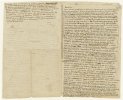
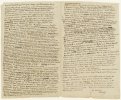
1r:1
My dear Theo,
On the evening of the day we spent together,
2 which for me passed as if in a twinkling, I want to write to you after all. It was a great joy for me to see and talk to you again, and it’s fortunate that such a day that passes in a twinkling and a joy of such short duration nevertheless remains in our memory, and that the remembrance of it is of a lasting nature. After we’d taken leave of each other I walked back, not the shortest way but along Trekweg.
3 There are workshops of all kinds there that look pleasant, especially lit up in the evening, which also speak in their own way to us who are, after all, labourers and workers, each in the sphere and in the work whereunto we have been called,
4 if only we care to listen, for they say, work while it is day, before the night cometh, when no man can work,
5 and they remind us that the Father worketh hitherto, and that we too must work.
6It was the very moment when the street-sweepers were coming home with their carts with old white horses, there was a long line of those carts standing by the so-called sludge works
7 at the beginning of Trekweg. Some of those old white horses resemble a certain old aquatint that you perhaps know, an engraving with no very great artistic value but which nevertheless struck me and made an impression on me. I mean the last of the series of prints titled ‘The life of a horse’.
8 That print depicts an old white horse, emaciated and spent and worn out to death by a long life of heavy labour and much and difficult work. The poor animal stands in an indescribably lonely and forsaken place, a plain with lank, withered grass and here and there a twisted tree, bent and cracked by the storm wind. On the ground lies a skull and in the distance, in the background, the bleached skeleton of a horse lying next to a hut, where the man who slaughters horses lives.
A stormy sky hangs over the whole, it’s a foul and bleak day, sombre and dark weather. It’s a sorrowful and profoundly melancholy scene that must move everyone who knows and feels that we, too, must one day go through that which we call dying, and that at the end of human life there are tears or grey hair.
9 What lies beyond is a great mystery that God alone comprehends, who has however revealed this irrefutably in His word, that there is a resurrection of the dead.
10The poor horse — the old faithful servant, stands patient and submissive, but courageous nonetheless and as resolute, as it were, as the old guard who said ‘the guard dies but does not surrender’
11 — waits for its final hour. I couldn’t help thinking of that print this evening when I saw those dust-cart horses. And now, as far as the drivers themselves are concerned, with their dirty, dingy clothes, they seemed to be sunk or rooted in poverty almost more deeply than that long row or rather group of poor people drawn by master
Degroux in his paupers’ pew.
12 Write and tell me if you know that print. I’d like to speak to the dustmen, if they would only come and sit in the paupers’ pew and consider it worthwhile to come and hear about the gospel and the lot of the poor and God, too, their Keeper and their Shade upon their right hand.
13 You see, it always strikes me and it is remarkable, when we see the image of unutterable and indescribable forsakenness — of loneliness — of poverty and misery, the end of things or their extremity — the thought of God comes to mind. At least this is the case with me, and doesn’t
Pa also say: There is no place I would rather speak than a cemetery, for there we are all on equal ground — there we not only stand on equal ground but there we also
feel that we are standing on equal ground, and elsewhere we don’t always feel that.
I’m glad that we saw the museum
14 together, especially the works by
Degroux15 and
Leys16 and so many other remarkable paintings, such as that landscape by
Coosemans,
17 among others. I’m very happy about the two prints you gave me, but you should have let me give you that small etching, The three mills.
18 Now you’ve paid it all yourself, not just half of it as I had so wished — you must keep it in your scrapbook, however, because it’s remarkable, even though it isn’t very well executed. In my ignorance I’d think it attributable to
Peasant Bruegel rather than to
Velvet Brueghel.
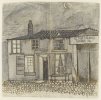
19 I hereby enclose that scratch, ‘The Au charbonnage café’.
20 I should really rather like to start making rough sketches of some of the many things one meets along the way, but considering I wouldn’t actually do it very well and it would most likely keep me from my real work, it’s better I don’t begin. As soon as I got home I began working on a sermon on ‘the barren fig tree’, Luke XIII:6-9.
1v:2 I sincerely hope that you’ll have had good days at home, that you also will have stayed over Sunday and found things well at Princenhage.
21When you arrive home in The Hague write a quick note if you can find the time, and be sure to give my warm regards to
the Rooses.
That little drawing, ‘The Au charbonnage café’ is really nothing special, but the reason I couldn’t help making it is because one sees so many coalmen, and they really are a remarkable people. This little house is not far from Trekweg, it’s actually a simple inn right next to the big workplace where the workers come in their free time to eat their bread and drink a glass of beer.
Back during my time in England I applied for a position as an evangelist among the coal-miners, but they brushed my request aside and said I had to be at least 25 years old.
22 You surely know that one of the root or fundamental truths, not only of the gospel but of the entire Bible, is ‘the light that dawns in the darkness’.
From darkness to Light.
23 Well then, who will most certainly need it, who will have an ear to hear it? Experience has taught us that those who work in darkness, in the heart of the earth like the mine-workers in the black coal-mines, among others, are very moved by the message of the gospel and also believe it. In the south of Belgium, in Hainaut, from around the area of Mons to the French borders
24 and even extending far beyond them, there is a region called the Borinage, where there is one of those populations of labourers who work in the many coal-mines. I found this and other things about them in a geography book:
25 The Borins (people who live in the Borinage, an area west of Mons) do nothing but mine coal. They’re an impressive sight, these coal-mines, opened up 300 metres underground, down which a working population worthy of our respect and sympathy descends every day. The coal-miner is a type peculiar to the Borinage; daylight hardly exists for him, and he scarcely enjoys the sun’s rays except on Sunday. He works with great difficulty by the light of a lamp whose illumination is pale and feeble, in a narrow gallery, his body bent double, and sometimes forced to crawl; his work is to pull from the earth’s entrails this mineral substance whose great usefulness we know, he thus works in the midst of a thousand constantly recurring dangers, but the Belgian foreman has a cheerful character, he’s used to this way of life, and when he goes down the pit, his hat topped with a little lamp whose job is to guide him in the darkness, he entrusts himself to his God Who sees his labours and Who protects him, his wife and his children. His clothing consists of a hat of boiled leather, a jacket and a pair of canvas trousers. So the Borinage lies to the south of Lessines,
26 where one finds the stone-quarries.
I should like to go there as an evangelist. The three-month trial period set by Messrs
De Jonge and the
Rev. Pieterszen is nearly over.
27 Paul spent three years in Arabia before he became active as a preacher and began his great missionary journeys and his actual work among the heathens.
28 If I could spend three years or so in a similar region, working in peace and always learning and observing, then I wouldn’t return from there without having something to say that is indeed worth hearing;
29 I say this in all humility yet with frankness. If God wills it and spares my life,
30 I’d be ready by about the age of 30 and could begin, with my special training and experience, having more mastery of my affairs and more maturity for the work than I do now. I’m writing this to you again, even though we’ve already talked about it. There are already a number of small Protestant congregations in the Borinage, and certainly schools as well, may God point me to a place where I can be active as an evangelist in the way we spoke about, by preaching the gospel to the poor, thus to those who have need of it and for whom it is suited to perfection, and devoting my time during the week to teaching.
1v:3 You’ve no doubt been to Saint-Gilles.
31 I once took a walk from there to the ‘old boundary mark’. Where the road to Mont Saint Jean begins there’s another hill, the Alsemberg. Here, on the right, is the cemetery of Saint-Gilles, full of cedars and ivy, from which one can look out over the city. Further on one comes to Forest. The region is very picturesque there, standing on the high slopes are old houses like the huts in the dunes that
Bosboom painted.
32 One sees people doing all kinds of farm work, sowing wheat, lifting potatoes, washing turnips, and everything, right down to wood-gathering, is picturesque and looks very much like Montmartre.
There are old houses with ivy or Virginia creeper and charming inns, among the houses I noticed was that of a mustard-maker, one
Verkissen.
33 His place would be perfect for a painting by
Thijs Maris, for example. There are places here and there where stones are found and therefore small quarries to which sunken roads with the deep ruts of cart tracks lead, where one sees small white horses with red tassels and drivers with blue smocks, and the shepherd is not lacking, nor old women in black with white caps reminiscent of those by
Degroux. There are also places here — as there are everywhere, for that matter, thank God — where one feels at home more than elsewhere, where one gets a remarkable, familiar feeling like homesickness, which has something bitterly melancholy about it but which nevertheless strengthens and awakens the spirit in us and gives us new strength and appetite for work and stimulates us, we know not how or why. That day I walked on, past Forest, and took a side road to an old church
34 overgrown with ivy. I saw many lime trees, even more entwined with one another and even more Gothic, so to speak, than those we saw in the park, and at the side of the sunken road leading to the cemetery twisted bushes and the roots of trees, as gnarled as those
Dürer etched in ‘Knight, Death and the Devil’.
35 Have you ever seen a painting, or rather a photo of it, by
Carlo Dolci, The Garden of Olives?
36 There’s something Rembrandtesque about it, saw it recently. You no doubt know the large, rough etching of the same subject after
Rembrandt,
37 being the pendant of the other, Reading the Bible, with those two women and the cradle.
38 It came to mind after you told me that you had seen the painting by
père Corot of the same subject; I saw it at the exhibition of his work shortly after he died,
39 and it moved me deeply.
How much there is in art that is beautiful, if only one can remember what one has seen, one is never empty or truly lonely, and never alone.
Adieu Theo, I shake your hand right heartily in thought, I wish you well, may you thrive in your work and encounter many good things on your path in life, such as stay in the memory and make us rich though we seemingly have nothing.
40 If you see
Borchers sometime, be so good as to tell him that I thank him very much for his letter of some time ago. If you go to
Mauve’s, give him my regards, and believe me
Your loving brother
Vincent
I kept this letter for a couple of days. 15 Nov. has passed, so the three months are up. Spoke with the
Rev. De Jonge and with Master
Bokma,
41 they say there is no opportunity to be at the school under the same conditions they offer to native Flemings — I can attend the lessons, for free if necessary — but this is the only privilege — in order to stay, therefore, I would need to have more financial means at my disposal than I do now, which is none. So I’ll probably soon try the Borinage plan.
42 Once out of the city I shan’t easily return to a big city. It wouldn’t be easy to live without believing in Him and without having the faith of old
43 in Him, and without that one would lose heart.



![[2441]](/vg/interface/artworkref.png "Vincent van Gogh - Old nag (F 1032 / JH 368) (Click to view image)")
![[145]](/vg/illustrations/145t.jpg "Jean Baptiste Armand Guillaumin - Nude woman on a bed")
![[2441]](/vg/illustrations/2441t.jpg "Vincent van Gogh - Old nag (F 1032 / JH 368)")
![[134]](/vg/illustrations/134t.jpg "Charles Camille Auguste Degroux - The paupers’ pew")
![[1880]](/vg/illustrations/1880t.jpg "Charles Camille Auguste Degroux - The paupers’ pew (1854)")
![[130]](/vg/illustrations/130t.jpg "Jean Léon Gérôme - The two augurs")
![[139]](/vg/illustrations/139t.jpg "Charles Camille Auguste Degroux - The drunkard")
![[140]](/vg/illustrations/140t.jpg "Charles Camille Auguste Degroux - The pilgrimage to Saint-Guidon in Anderlecht")
![[135]](/vg/illustrations/135t.jpg "Charles Camille Auguste Degroux - Saying grace")
![[138]](/vg/illustrations/138t.jpg "Charles Camille Auguste Degroux - The conscript’s departure")
![[131]](/vg/illustrations/131t.jpg "Jean Alexandre Joseph Falguière - Phryné (after Jean Léon Gérôme)")
![[132]](/vg/illustrations/132t.jpg "Jean Léon Gérôme - The prisoner (1863)")
![[137]](/vg/illustrations/137t.jpg "Charles Camille Auguste Degroux - The conscript’s return")
![[654]](/vg/illustrations/654t.jpg "Jan Brueghel I (Velvet Brueghel) - The three windmills")
![[1882]](/vg/illustrations/1882t.jpg "Albrecht Dürer - Knight, Death and the Devil")
![[780]](/vg/illustrations/780t.jpg "Carlo (Carlino) Dolci - Christ in Gethsemane")
![[1883]](/vg/illustrations/1883t.jpg "Rembrandt van Rijn - Christ in Gethsemane")
![[1705]](/vg/illustrations/1705t.jpg "Jean Baptiste Camille Corot - Christ on the Mount of Olives")